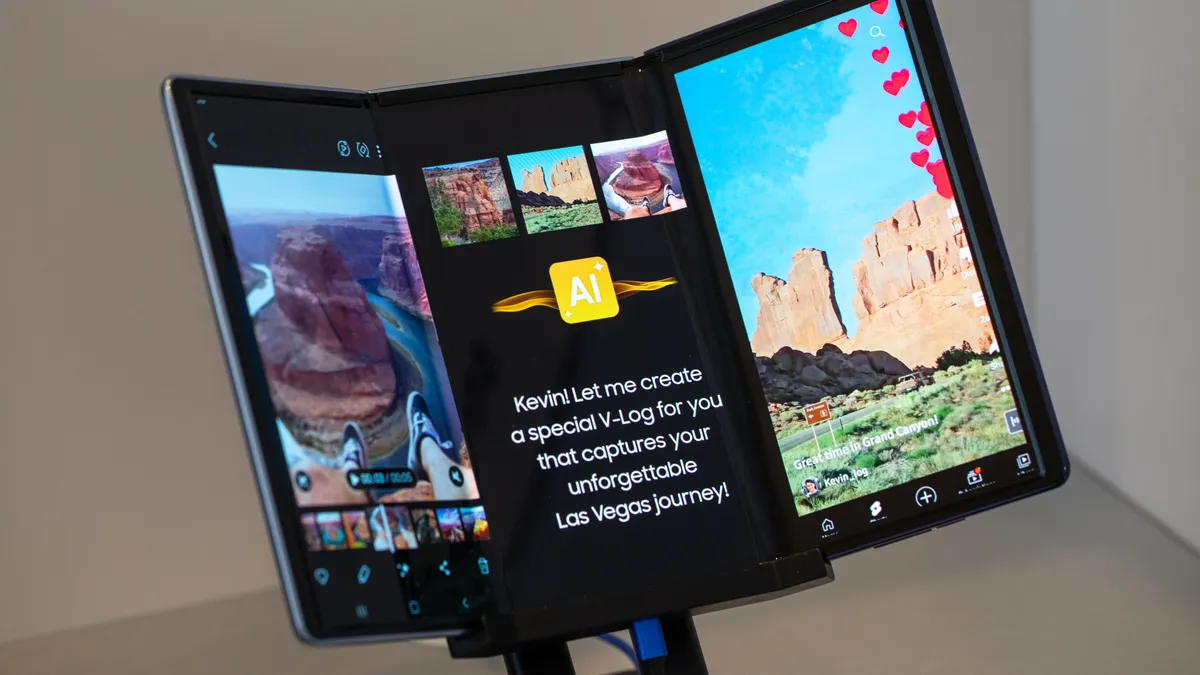
Samsung has been at the forefront of foldable smartphone technology since launching the original Galaxy Fold in 2019. Now, with the unveiling of the Galaxy Z TriFold in December 2025, the company takes its boldest step yet in reimagining what a mobile device can be. This isn’t just another incremental update in the foldable category—it’s a fundamentally new form factor that transforms how we think about the relationship between smartphones and tablets, portability and productivity, compromise and capability.
The Engineering Marvel of Multi-Folding Design
The Galaxy Z TriFold represents the culmination of Samsung’s decade-long journey in foldable innovation. Unlike traditional foldables that feature a single hinge, the Z TriFold incorporates two precision-engineered hinges that enable the device to fold twice, creating three distinct panels. When fully unfolded, these panels combine to deliver a stunning 10-inch display, offering a viewing experience that rivals many tablets while maintaining a profile slim enough to slip into a pocket when folded.
The technical challenges involved in creating a device that folds twice are considerable. Each hinge must operate smoothly and reliably through thousands of folding cycles while maintaining perfect alignment of the display panels. Samsung’s engineering team has developed a sophisticated hinge structure that allows the screen panels to meet securely with minimal gap, enabling the device to remain remarkably thin even when folded. The company reports the folded thickness at just 12.9 millimeters, only slightly thicker than the Galaxy Z Fold 6.
The Z TriFold employs an inward-folding design that protects the expansive main display when the device is closed. This design choice, inspired by Samsung’s extensive experience in the foldable category, shields the screen from potential damage while providing a more compact form factor. The folding mechanism has been meticulously engineered for intuitive opening and closing, with an innovative auto-alert system that warns users of incorrect folding through a combination of on-screen notifications and haptic feedback.
Display Technology: A New Standard for Mobile Screens
The Galaxy Z TriFold’s 10-inch main display represents a significant achievement in foldable screen technology. Samsung has developed a reinforced display structure specifically designed to withstand the unique stresses of a dual-folding design. A new shock-absorbing layer sits beneath a reinforced overcoat, providing enhanced durability across the two fold points. The display achieves a resolution of 2160 x 1584 pixels, delivering sharp, vibrant images with excellent color accuracy and clarity.
When folded, the Z TriFold reveals a 6.5-inch cover display that functions as a conventional smartphone screen. This external display ensures that common tasks—checking messages, taking calls, quick photo captures—can be accomplished without unfolding the device. The thoughtful implementation of the cover display demonstrates Samsung’s understanding that a foldable device must work seamlessly in both its compact and expanded configurations.
The main display’s 10-inch size creates fascinating new possibilities for mobile computing. It’s large enough to provide a genuinely tablet-like experience for content consumption, document editing, and multitasking, yet it folds into a device that remains portable. This bridges the gap between phones and tablets in a way that single-fold devices cannot match.
Productivity Reimagined
The Z TriFold’s unique three-panel design enables unprecedented multitasking capabilities on a mobile device. The Multi Window feature allows users to run three applications simultaneously in portrait orientation, side by side by side. Imagine reviewing a document while referencing a spreadsheet and participating in a video call—all on a single screen without constantly switching between apps.
For professionals who need to remain productive while mobile, this capability is transformative. The device essentially provides a portable workstation that fits in your pocket. Samsung DeX support takes this further, enabling a full desktop computing environment complete with keyboard and mouse support. Connect the Z TriFold to an external display, and it becomes the brain of a complete computing setup, eliminating the need to carry a separate laptop for many users.
The enhanced screen real estate makes the Z TriFold particularly compelling for content creators, business professionals, and anyone who regularly works with complex information. Architects can review detailed plans, designers can work on layouts, and financial professionals can analyze data—all with a level of clarity and workspace that was previously impossible on a mobile device.
Technical Specifications and Performance
The Z TriFold packs flagship-level performance into its innovative form factor. While Samsung hasn’t disclosed all specifications, the device is expected to feature the latest Snapdragon processor, ensuring smooth performance even when running multiple demanding applications simultaneously. The battery capacity is the largest of any Samsung foldable device, with support for ultra-fast charging that reaches 50 percent capacity in just 30 minutes.
The camera system benefits from Samsung’s latest mobile imaging technology, though specific details remain under wraps. What’s clear is that Samsung has prioritized creating a complete flagship experience that doesn’t compromise on any traditional smartphone capabilities despite the innovative form factor.
The durability improvements extend beyond the display to the overall construction. Samsung has refined the materials and engineering processes learned from previous foldable generations, creating a device that should withstand the rigors of daily use despite its complexity.
Market Strategy and Availability
Samsung’s approach to launching the Z TriFold reveals a measured strategy for introducing this radical new form factor. The device initially launches in South Korea in late December 2025, with U.S. availability planned for early 2026. This staggered release allows Samsung to gather real-world usage data and feedback before expanding to all markets.
The Z TriFold is positioned as a premium device, reflecting both its cutting-edge technology and its role as a proving ground for future foldable innovations. Samsung views this device as a technological showcase and a prototype for broader commercialization, assessing durability, hinge design, and software functionality through actual user experience.
Competitive Landscape
Samsung’s Z TriFold arrives as competition in the foldable space intensifies. Chinese manufacturers have introduced their own multi-folding devices, and rumors persist of Apple’s eventual entry into the foldable market. The Z TriFold represents Samsung’s assertion of technological leadership in a category it pioneered, demonstrating capabilities that competitors have yet to match.
The device’s significance extends beyond its immediate market impact. It establishes new benchmarks for what’s possible in mobile form factors and pushes the entire industry toward more ambitious designs. Even if the Z TriFold remains a niche product, its influence on future device designs will likely be substantial.
Challenges and Considerations
Despite its impressive capabilities, the Z TriFold faces challenges. The complexity of its dual-hinge design raises questions about long-term durability. The premium pricing will limit its audience to early adopters and professionals who can justify the investment. Software optimization for the unusual aspect ratios and form factor will require ongoing attention from developers.
The device’s thickness when folded, while impressive given the engineering challenges, still makes it noticeably bulkier than conventional smartphones. Users will need to evaluate whether the expanded screen capabilities justify carrying a thicker device.
Looking Forward
The Galaxy Z TriFold represents more than just Samsung’s latest product—it’s a vision of mobile computing’s future. As work and personal life increasingly demand devices that can adapt to different contexts and requirements, form factors that offer genuine flexibility become more valuable. A device that works equally well for quick communications, media consumption, and serious productivity tasks addresses real needs in ways that conventional smartphones cannot.
Samsung’s willingness to push boundaries and accept the risks inherent in pioneering new form factors has driven the entire mobile industry forward. The Z TriFold continues this tradition, offering a glimpse of possibilities that will likely influence smartphone design for years to come. Whether this specific form factor becomes mainstream or remains a specialized tool, it demonstrates that there’s still room for radical innovation in mobile technology—and that the future of smartphones may look very different from their present.