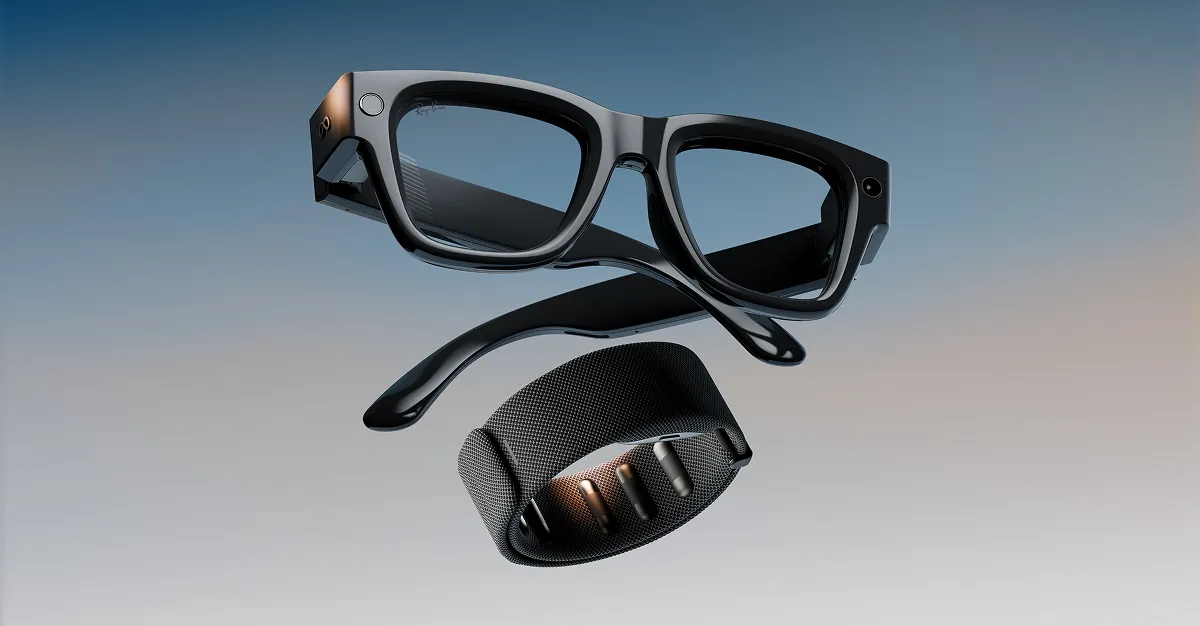
Meta has taken a significant leap forward in wearable technology with the announcement of the Meta Ray-Ban Display glasses at Connect 2025. These aren’t just another iteration of smart glasses—they represent a fundamental shift in how we’ll interact with digital information in our daily lives. By combining an in-lens display with the revolutionary Meta Neural Band for gesture-based control, Meta is bringing practical augmented reality to consumers in a form factor that looks like regular designer eyewear.
The Display Revolution
What sets the Meta Ray-Ban Display apart from previous smart glasses is its integrated visual display. Built into the right lens, the full-color, high-resolution 600×600 pixel display delivers information directly into your field of view without obstructing your natural vision. This heads-up display approach represents a crucial middle ground between traditional smart glasses that rely solely on audio feedback and full AR headsets that overlay heavy digital content on your entire visual field.
The display technology enables a wide range of practical applications. Text messages appear as floating notifications you can read at a glance. Navigation directions overlay subtle arrows guiding your path. Calendar reminders pop up when needed. Video calls place the caller’s image in your peripheral vision, allowing you to maintain a conversation while remaining engaged with your physical surroundings. This careful balance between digital augmentation and physical presence addresses one of the core challenges that has plagued earlier smart glasses attempts.
Meta describes the display as extremely high resolution, and early demonstrations suggest that text and icons appear sharp and legible even in varied lighting conditions. The display is translucent, ensuring it doesn’t block your view of the world, though users can see overlaid information clearly when they choose to focus on it. This optical engineering represents years of research into making digital displays that work harmoniously with human vision rather than fighting against it.
Neural Band: Control Through Subtle Gestures
Perhaps even more groundbreaking than the display itself is the Meta Neural Band, a wrist-worn device that uses electromyography technology to detect the subtle electrical signals your muscles generate when you move your fingers and hand. This EMG-based approach enables you to control the glasses through tiny, almost imperceptible gestures—no need for obvious hand waving or voice commands that might feel awkward in social situations.
The Neural Band interprets micro-movements of your fingers as input commands. Subtle pinches, swipes, and taps that would be invisible to onlookers translate into interactions with the information displayed in your glasses. Want to scroll through a message? A tiny finger swipe does it. Need to select an option? A delicate pinch gesture makes the selection. This remarkably intimate control method feels almost like thought control, as the gestures required are so minimal that they become nearly automatic with practice.
Each pair of Meta Ray-Ban Display glasses comes with a dedicated Neural Band, emphasizing that Meta views the wrist-worn controller as essential rather than optional. The band is water-resistant and designed for all-day wear, with battery life sufficient to last through typical daily usage. The pairing between glasses and band is seamless, with the devices communicating wirelessly to provide lag-free response to your inputs.
The implications of this control method extend far beyond convenience. By enabling silent, discreet interaction with digital content, the Neural Band allows smart glasses to become socially acceptable in ways that voice-controlled or heavily gesture-based interfaces never could. You can respond to messages, check information, or control functions without disrupting conversations or drawing attention to your technology use.
Practical Applications
The real power of the Meta Ray-Ban Display lies in how it transforms everyday activities. Navigation becomes more natural when directions appear in your field of view rather than requiring you to glance at your phone. You can follow walking or driving directions while maintaining full awareness of your surroundings, reducing the cognitive load and safety concerns associated with phone-based navigation.
Communication takes on new dimensions. Text messages can be read instantly, and quick replies can be sent by selecting pre-written phrases or dictating responses using the glasses’ built-in microphone. Video calls place the caller’s face in your vision, enabling more natural conversation than staring at a phone screen. The ability to stay connected without constantly reaching for your phone represents a genuine quality-of-life improvement.
Real-time language translation showcases the practical magic of AR glasses. Speak to someone in a different language, and translations appear in your vision, facilitating communication that would otherwise be challenging. This feature, powered by Meta AI, demonstrates how artificial intelligence and augmented reality can combine to solve real human problems.
Productivity applications are equally compelling. Reminders and calendar notifications appear when relevant, helping you stay on top of commitments without constant phone checking. Reference information can be called up when needed, whether you’re shopping for groceries and need to check a list or are in a meeting and need to review notes. The glasses effectively give you an always-available information assistant that doesn’t require device juggling.
The Meta AI assistant running on the glasses can answer questions, provide information, and help with tasks throughout your day. Unlike phone-based assistants that require you to pull out a device and speak to it, the glasses-based AI feels more integrated into your natural flow of activity.
Design and Wearability
Meta’s partnership with Ray-Ban ensures that the Display glasses maintain the iconic styling that has made Ray-Ban a fashion staple for decades. The glasses are available in various classic frame styles, ensuring users can find options that match their personal aesthetic. This attention to fashion is crucial—smart glasses will only achieve mainstream adoption if people actually want to wear them as eyewear, not just as technology.
The glasses are water-resistant, providing peace of mind for everyday use. Weight distribution has been carefully engineered to maintain comfort during extended wear. The integration of display technology and electronics into eyeglass frames without creating a bulky or awkward appearance represents a significant achievement in miniaturization and industrial design.
Battery life for the glasses themselves is sufficient for several hours of active use, with the ability to charge via a standard case when not in use. This mirrors the approach successful wireless earbuds have taken, making charging a natural part of storage rather than an extra step.
Price and Availability
The Meta Ray-Ban Display glasses are priced at $799, positioning them as a premium technology product that’s nonetheless within reach for enthusiasts and early adopters. This pricing reflects both the sophisticated technology packed into the devices and Meta’s intention to make AR glasses accessible rather than treating them as exclusive luxury items.
Availability was announced for several weeks after the Connect 2025 conference, with Meta emphasizing that initial shipments would be limited as production ramps up. The company is taking a measured approach to launch, likely learning from previous technology releases where overwhelming demand outstripped supply.
Challenges and Considerations
Despite the impressive technology, the Meta Ray-Ban Display faces challenges. Privacy concerns around cameras and recording capabilities in eyewear have plagued smart glasses since Google Glass. Meta has implemented indicators to show when recording is active, but social acceptance remains a hurdle.
The requirement to wear the Neural Band at all times limits the glasses’ utility if you forget or choose not to wear the wristband. While the glasses can still function for some tasks without it, the full experience depends on having both devices.
Battery life, while acceptable, means the glasses aren’t truly all-day devices for heavy users. You’ll need to be mindful of charge levels and may need to charge midday for extended use.
Looking Forward
The Meta Ray-Ban Display represents a credible vision of practical augmented reality. By focusing on useful, focused applications rather than trying to replace your entire visual field with digital content, Meta has created a product that could genuinely improve daily life rather than just demonstrating impressive technology. The Neural Band’s gesture control solves the interaction problem that has challenged previous smart glasses, enabling natural, discreet control that works in real-world social contexts. Whether these glasses become the breakthrough product that finally brings AR to the masses remains to be seen, but they represent the most compelling attempt yet to make smart glasses that people actually want to wear.