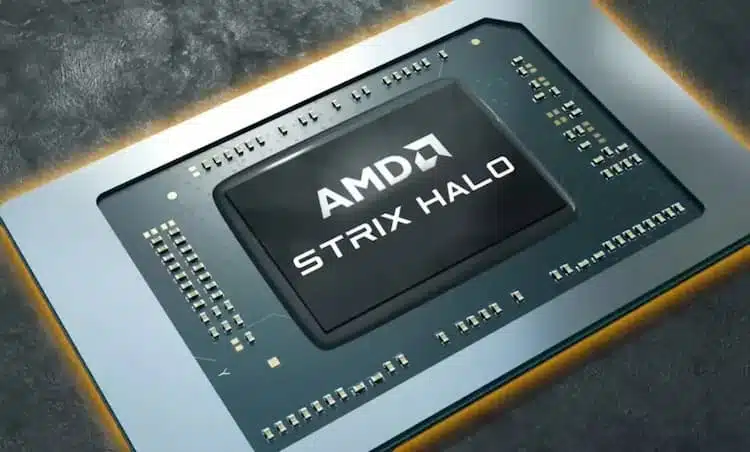
AMD launched the Ryzen AI Max+ 395 on January 6, 2025, marking a pivotal moment in mobile computing history. This Strix Halo architecture processor isn’t just another incremental upgrade—it represents AMD’s boldest attempt to redefine what’s possible in a laptop form factor. With groundbreaking specifications and performance that challenges desktop-class processors, the Ryzen AI Max+ 395 has set a new standard for mobile workstations and content creation laptops.
Strix Halo Architecture: A Technical Marvel
The Ryzen AI Max+ 395 is built on TSMC’s advanced 4nm manufacturing process, representing the cutting edge of semiconductor fabrication. This die shrink enables AMD to pack an unprecedented amount of computing power into a thermal envelope suitable for laptop chassis. The processor features 16 Zen 5 cores arranged in a configuration designed to balance performance and efficiency.
These aren’t ordinary cores. AMD has implemented full Zen 5 architecture with all its improvements—enhanced branch prediction, wider execution pipelines, and improved cache hierarchies. Each core can handle two threads simultaneously through SMT (Simultaneous Multi-Threading), giving the processor a total thread count of 32. This massive core count puts the Ryzen AI Max+ 395 on par with many desktop processors, a feat rarely achieved in mobile platforms.
The processor can boost up to 5.1 GHz on single-threaded workloads, ensuring snappy responsiveness in everyday applications. When all cores are engaged, the processor maintains impressive clock speeds that enable sustained performance during extended render jobs, compilation tasks, or parallel computational workloads.
Unified Memory: The Game Changer
Perhaps the most revolutionary aspect of the Ryzen AI Max+ 395 is its unified memory architecture. The processor supports up to 128GB of LPDDR5X-8000 memory shared between the CPU and GPU. This represents a paradigm shift from traditional laptop designs where the GPU is limited to dedicated VRAM or shared system memory in smaller quantities.
With AMD’s Variable Graphics Memory technology, up to 96GB of the system memory can be allocated as VRAM for the integrated Radeon 8060S graphics. This massive memory pool enables workloads that were previously impossible on laptops—running large language models locally, editing 8K video timelines, working with massive RAW photo libraries, or creating complex 3D scenes.
The unified memory architecture eliminates the traditional bottleneck of copying data between system RAM and video memory. Applications can access the full memory pool with consistent latency, dramatically improving performance in memory-intensive tasks. The LPDDR5X-8000 specification provides 128GB/s of memory bandwidth, adequate for feeding both the CPU and GPU cores.
Radeon 8060S: Integrated Graphics Powerhouse
The integrated Radeon 8060S graphics adapter based on RDNA 3+ architecture features 40 compute units—more than many discrete mobile GPUs from just a generation ago. These CUs operate at competitive clock speeds and can leverage the massive unified memory pool to deliver performance that approaches entry-level discrete graphics cards.
For content creators, the Radeon 8060S accelerates video encoding and decoding through hardware-based AV1 support, H.265/HEVC, and H.264 codecs. The media engines enable real-time scrubbing of 4K footage in editing applications and fast export times. For 3D artists and CAD professionals, the GPU’s compute performance enables viewport navigation in complex scenes and real-time ray tracing preview in supported applications.
Gamers will find the Radeon 8060S capable of running modern titles at 1080p with medium to high settings, depending on the game’s requirements. Esports titles run at high frame rates, making the processor suitable for competitive gaming. The combination of adequate gaming performance and professional content creation capabilities makes laptops with the Ryzen AI Max+ 395 incredibly versatile.
AI Acceleration: XDNA 2 Neural Engine
AMD has integrated its XDNA 2 neural processing unit capable of 50 TOPS (Tera Operations Per Second) of AI inferencing performance. This dedicated AI accelerator handles machine learning workloads more efficiently than running them on the CPU or GPU, reducing power consumption and freeing up those resources for other tasks.
The XDNA 2 NPU enables on-device AI features like real-time background blur in video calls, noise suppression, intelligent image enhancement, and local processing of large language models. As AI features become increasingly integrated into productivity applications, having dedicated hardware acceleration becomes essential for responsive performance.
Developers building AI applications benefit from AMD’s ROCm software stack, which provides comprehensive tools and libraries for leveraging the NPU’s capabilities. The combination of the XDNA 2 NPU, powerful GPU compute, and abundant unified memory creates an ideal platform for AI development and inference.
Connectivity and Modern Features
The Ryzen AI Max+ 395 includes support for PCIe 4.0, providing ample bandwidth for fast NVMe SSDs and external peripherals. USB 4 support enables Thunderbolt 3-compatible devices, high-speed storage arrays, and external GPU enclosures if even more graphics horsepower is needed.
The processor supports DisplayPort 2.1 and HDMI 2.1, enabling connections to high-resolution displays including 4K at 144Hz or 8K at 60Hz. Content creators working with high-resolution monitors or multiple displays benefit from the robust display connectivity options.
Wi-Fi 7 and Bluetooth 5.4 support ensure cutting-edge wireless connectivity. The latest Wi-Fi standard provides multi-gigabit wireless speeds when connected to compatible routers, making cloud-based workflows more practical.
Performance: Desktop-Class Power in Laptop Form
Benchmarks reveal the Ryzen AI Max+ 395 delivering performance that competes with desktop processors in many workloads. Multi-threaded tasks like video rendering, 3D rendering, code compilation, and data analysis see dramatic speedups compared to previous-generation mobile processors.
In Cinebench R23, the processor delivers multi-core scores that rival desktop chips with similar core counts. Single-threaded performance is competitive with the fastest mobile processors, ensuring snappy responsiveness in everyday use.
Content creation benchmarks show impressive results. Premiere Pro timeline scrubbing is smooth even with complex effects stacks. After Effects composition rendering benefits from both the strong CPU performance and GPU acceleration. Lightroom catalog processing and export operations are dramatically faster than previous mobile solutions.
3D rendering in applications like Blender leverages both the CPU cores and GPU compute units. The abundant memory allows working with larger scenes than previously possible on laptops. Viewport performance remains smooth even with millions of polygons and complex shaders.
For developers, compilation times are dramatically reduced. Large codebases that once took minutes to build now compile in a fraction of the time. Virtual machines and containers run with minimal performance overhead, enabling sophisticated development environments on mobile hardware.
Real-World Applications and Use Cases
The Ryzen AI Max+ 395 excels in scenarios that demand sustained high performance. Video editors working on location can edit 4K or even 8K footage without transcoding to proxy formats. The processor handles multiple video streams, color grading, and effects in real-time.
Photographers benefit from the fast RAW processing and ability to work with large libraries. Batch processing operations that export hundreds of images complete quickly. AI-enhanced features like content-aware fill and noise reduction process in seconds rather than minutes.
3D artists and game developers can work on complex scenes using the same hardware that runs their final products. The ability to iterate quickly on designs accelerates creative workflows. The processor handles real-time ray tracing preview, enabling artists to see lighting changes immediately.
Data scientists and machine learning engineers can train models locally, iterate on algorithms, and run inference at scale. The 128GB memory capacity enables working with datasets that don’t fit in typical laptop memory configurations. The combination of CPU, GPU, and NPU resources provides flexibility in how workloads are executed.
Developers building cloud-native applications can run full development stacks locally, including multiple microservices, databases, and supporting infrastructure. The abundant cores and memory enable realistic testing environments that mirror production deployments.
Power Efficiency and Thermal Management
Despite its impressive performance, the Ryzen AI Max+ 395 maintains a configurable TDP (Thermal Design Power) that laptop manufacturers can tune between 35W and 120W depending on chassis capabilities and target use case. This flexibility enables the processor to be used in thin-and-light workstations as well as larger mobile workstation designs.
At lower TDP settings, the processor delivers impressive performance per watt, enabling all-day battery life in productivity workloads. When plugged in and configured for maximum performance, the processor unleashes its full capabilities for deadline-driven work.
The advanced 4nm manufacturing process contributes to excellent power efficiency. The processor intelligently powers down unused cores and components, minimizing idle power consumption. This results in battery life that extends well beyond what you’d expect from such a powerful processor.
Laptop manufacturers have implemented sophisticated cooling solutions to handle the processor’s thermal output. Vapor chamber cooling, multiple heat pipes, and large heat sinks enable sustained performance without thermal throttling. Fan profiles balance noise levels with cooling capacity, remaining relatively quiet during light tasks while ramping up under load.
Software Ecosystem and Compatibility
The Ryzen AI Max+ 395 benefits from mature driver support and broad application compatibility. AMD’s software team has optimized drivers for professional applications, ensuring stable performance in mission-critical workflows. Regular driver updates bring performance improvements and new feature support.
AMD’s Adrenalin software provides comprehensive control over GPU settings, enabling users to optimize performance for specific applications or manage power consumption for battery life. The software includes features like Radeon Super Resolution for upscaling game graphics and Radeon Anti-Lag for reduced input latency.
For professional users, AMD provides certified drivers for applications like AutoCAD, SolidWorks, and Adobe Creative Cloud. These drivers undergo extensive testing to ensure stability and optimal performance in professional environments.
Market Impact and Competition
The Ryzen AI Max+ 395 positions AMD as a serious competitor in the high-performance mobile market. The processor directly challenges Intel’s offerings while providing unique advantages through its unified memory architecture and strong integrated graphics performance.
For Apple’s M-series chips, the Ryzen AI Max+ 395 offers comparable unified memory benefits while maintaining Windows and Linux compatibility. Users who require specific software only available on x86 platforms now have a compelling mobile option that approaches Apple’s efficiency and integration.
Laptops featuring the Ryzen AI Max+ 395 target creative professionals, engineers, data scientists, and developers who need desktop-class performance in a mobile form factor. The typical user of this processor values performance over absolute battery life and needs a single computer that can handle everything from content creation to software development to occasional gaming.
Pricing and Value Proposition
Laptops featuring the Ryzen AI Max+ 395 typically start around $1,800 and can exceed $3,000 depending on configuration. While expensive, these systems offer value when compared to purchasing separate desktop and laptop computers. The ability to have full performance on the go justifies the premium for professionals whose work doesn’t stop at the office.
When configured with maximum memory (128GB), the price increases substantially, but for users whose workflows demand this capacity, the investment pays dividends in productivity. The alternative of working with memory-constrained systems results in slower workflows and frequent frustration.
The Future of Mobile Computing
The Ryzen AI Max+ 395 represents more than just a faster processor—it demonstrates a new approach to mobile computing architecture. By unifying memory and integrating high-performance CPU, GPU, and NPU components, AMD has created a platform that doesn’t require users to choose between portability and performance.
As software continues evolving to leverage AI capabilities and handle larger datasets, the architecture pioneered by the Ryzen AI Max+ 395 will become increasingly important. The processor has set a new baseline for what mobile workstations should deliver.
Conclusion: A Processor That Redefines Expectations
The AMD Ryzen AI Max+ 395 succeeds in its ambitious goal of bringing desktop-class performance to laptops. The combination of 16 Zen 5 cores, 40 compute units, 128GB of unified memory, and dedicated AI acceleration creates a platform capable of handling virtually any workload.
For professionals who depend on their computers for critical work, the Ryzen AI Max+ 395 offers the performance necessary to meet deadlines without compromise. The unified memory architecture eliminates traditional bottlenecks, while the strong integrated graphics reduce or eliminate the need for discrete GPUs.
While the processor commands premium pricing and requires substantial cooling, the performance delivered justifies the investment for users whose work demands it. The Ryzen AI Max+ 395 proves that mobile computing has reached a point where compromises are no longer necessary—you can genuinely have desktop performance in a laptop.